01
Strategy
Choose where the organization is going—and why it matters.
Business model, strategic direction, market position, priorities, profitability, and the measures that define meaningful progress.

Building Organizations That Scale
Align strategy, people, systems, and execution so your organization moves with clarity, adapts with confidence, and grows sustainably.
◉ Built for leaders,
backed by experience
♡ Human-centered.
Results-driven.
↗ Designed for every
organizational stage
⬡ One connected model
for the whole system
The Model
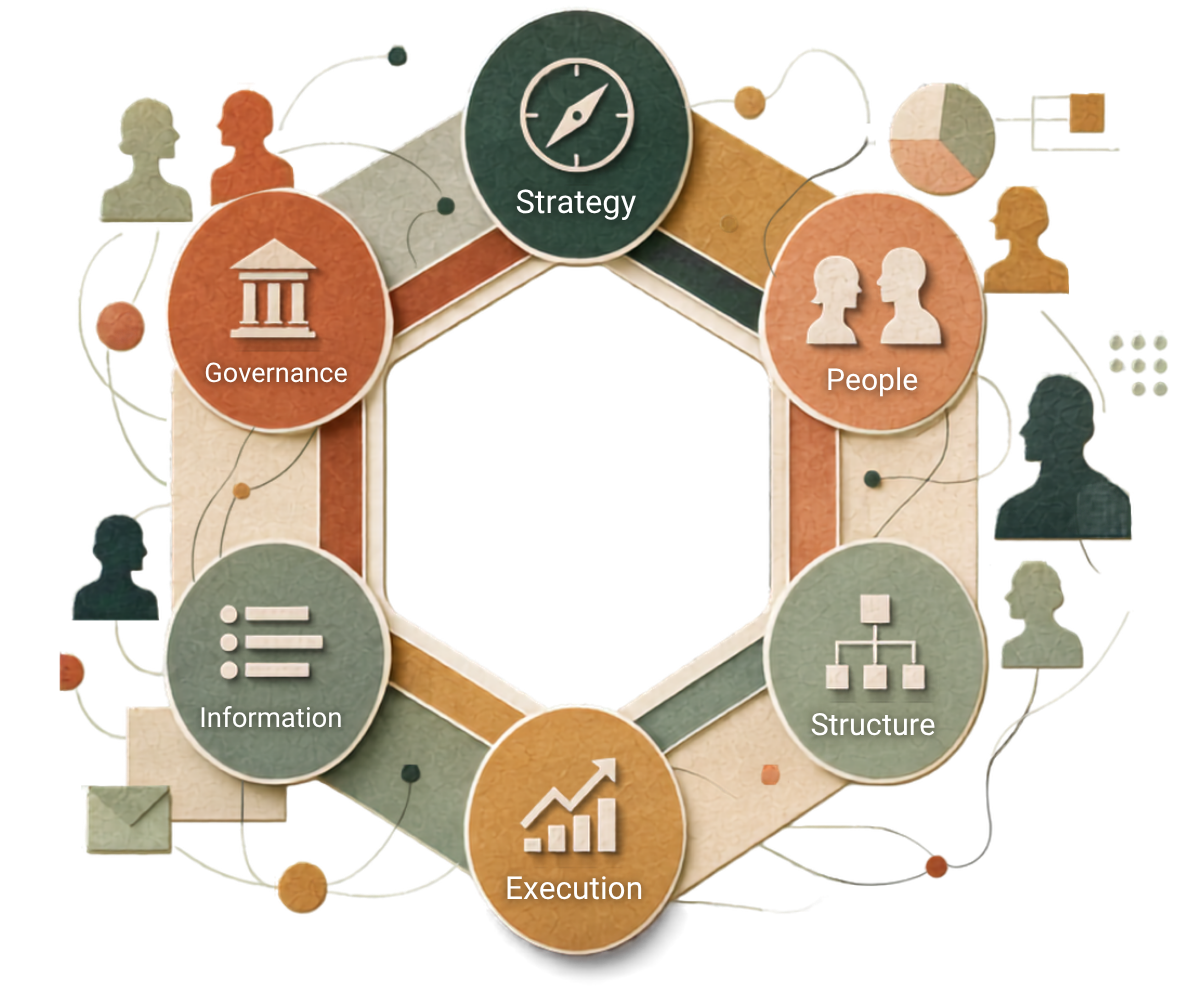
Every challenge has a primary home—but never only one cause.
The model gives leaders a shared language for locating issues, tracing their effects, and designing responses that hold together across the business.
Choose where the organization is going—and why it matters.
Business model, strategic direction, market position, priorities, profitability, and the measures that define meaningful progress.

Build the culture and capability to move there together.
Values, leadership, talent, learning, engagement, conflict management, and the everyday experience of work.

Give work a clear home, owner, and path across the business.
Organization design, roles, decision rights, handoffs, interdepartmental processes, and operating boundaries.

Turn intent into reliable, excellent delivery.
Plans, workflows, resources, performance rhythms, service quality, problem solving, and disciplined follow-through.

Make the right knowledge available for better decisions.
Data, systems, documentation, communication, reporting, knowledge flow, and the signals leaders need to act.

Create accountability, assurance, and continuous improvement.
Policies, compliance, risk, audits, accountability, review cycles, and the discipline to learn and improve.
The DIDI Process
Define. Identify. Diagnose. Improve.
Describe the observable, undesirable business condition without assuming its cause.
Select the repeatable organizational ability that must produce the required outcome.
Examine the capability through Strategy, People, Structure, Execution, Information, and Governance.
Prioritize, implement, measure, and sustain coordinated improvements to the capability.
Why It Works
Most operating models divide the business into functions. Six Pillars Model looks at the relationships between them.
Ways to Engage
For Organizations
Use the model to diagnose organizational friction, establish ownership, align leaders, and build a practical path to scale.
Explore Advisory Work →For Practitioners
Certification classes will equip leaders and advisors with the method, assessment tools, facilitation guides, and resources.
View Certification →For Curious Leaders
Follow the ideas, conversations, and field notes shaping healthier organizations that can grow without losing their humanity.
Join the Community →See the Whole System
Clarity before activity.Organizational Advisory
For leaders navigating growth, recurring friction, unclear accountability, or a business that has outgrown the way it works today.
Certification
Certification classes are being developed for executives, people leaders, consultants, and transformation practitioners who want to use the framework in real organizations.
Framework foundations, diagnostic practice, pillar ownership, facilitation methods, case application, and access to practitioner tools and resources.
The Community
Join leaders and practitioners exploring what it takes to build organizations that are clear, capable, accountable, and deeply human.
Be Part of the Conversation →About the Model
Six Pillars Model is a practical framework for understanding how organizations really operate—not as isolated departments, but as one connected system.
It helps leaders locate the true source of friction, see the relationships around it, and design coordinated improvements that can hold as the organization grows.
Stay Connected
Use one form for certification updates, the weekly newsletter, consultancy—or any combination.